

This question sits at the heart of HTTPS. There’s no shared secret, the network is untrusted, and attackers can read or modify packets. Yet, every day our browser establishes secure connections in milliseconds.
This article builds that system from first principles starting with basic cryptography and ending with modern TLS handshake.
1. The Building Blocks
1.1 Symmetric Encryption - Fast but problematic
Symmetric encryption uses the same key for encryption and decryption.
Example algorithm: AES
Strength: extremely fast and is used for large data
Problem: the same key needs to be there with receiver. How to send the key securely?
If we already had a secure way to share the key, why not just use that to send the data?
1.2 Asymmetric Encryption - Solving Trust, not speed
Asymmetric encryption introduces key pairs:
Public key (shared openly)
Private key (kept secret)
Two different keys, different uses
Encrypt using public key → Decrypt using private key
Purpose: Confidentiality
Sign using private key → Verify using public key (Digital Signatures)
Purpose: Authenticity + Integrity
Asymmetric encryption is not used for bulk data since it’s too slow. It’s used to establish trust and identity
1.3 Hashing ensures integrity
A hash function (like SHA-256)
Takes in input of any size
produces fixed length output
is deterministic
is irreversible
Why Hashing?
To verify data integrity
If HASH(data1) == HASH(data2), then data1 == data2
2. Digital Signatures
Digital signature combines Hashing and asymmetric encryption
Let’s define:
HASH(k)→ hash of datakSign(pvt, k)→ sign using private keyVerify(pub, sig, k)→ verify using public key
Signing
h = HASH(k) , sig = Sign(pvt, h)
Verification
h1 = HASH(k), h2 = Verify(pub, sig)
if: h1 == h2 → trusted source
What does this give us?
Integrity → data wasn’t changed while it reached destination
Authenticity → signed by owner of private key
3. The Real Problem: Trust
At this point, we can verify signatures, but the bigger problem is:
How do we trust a public key?
Anyone can generate a (pub, pvt) key pair
So how do we know if the key actually belongs to example.com?
4. Public Key Infrastructure (PKI)
PKI solves the trust problem using hierarchy:
Root Certificate Authority (RCA)
Intermediate Certificate Authority (ICA)
Web Servers (Websites)
Key Concepts
Certificate → binds identity + public key
CA → entity that signs certificates
ICA → Intermediate Certificate Authority
RCA → Root Certificate Authority
Chain of Trust → Layered verification
How are certificates Issued
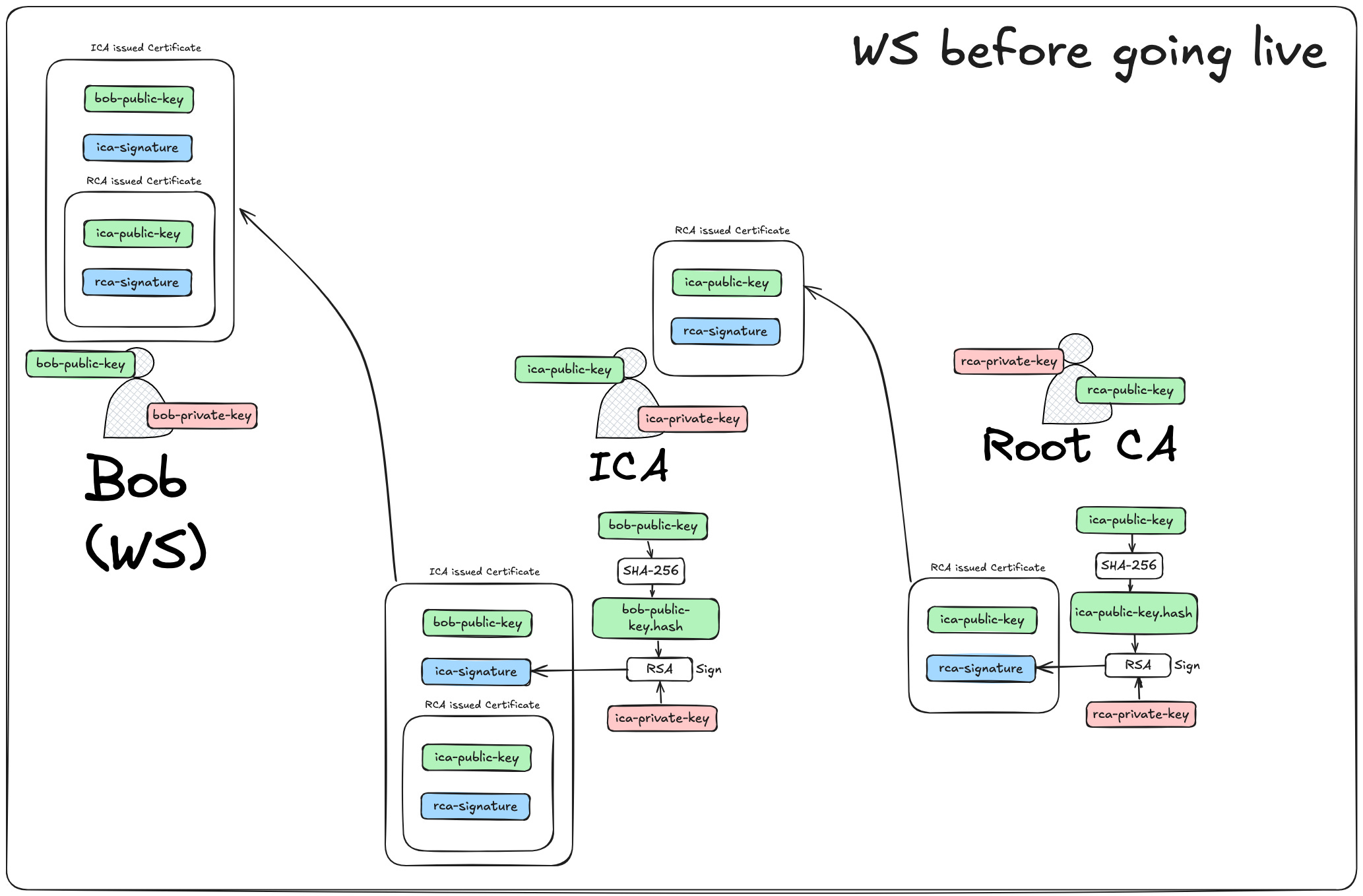
The diagram above shows how websites prepare for building trust among browsers (or User Agents) to be able to securely connect to them. To understand the flow, read the diagram from right to left.
Lets dig in deeper:
pub→ public keypvt→ private keyHASH(k)→ hash functionSign(pvt, k)→ signature
Step 1 : ICA gets signed certificate from Root CA
ICA generates:
ICA.pub, ICA.pvtICA sends a CSR (Certificate Signing Request) to Root CA.
Root CA:
h = HASH(ICA.pub)
sig = Sign(RCA.pvt, h)
Returns certificate:
(ICA.pub, sig)Step 2: Server gets signed by ICA
Web Server (WS) generates:
WS.pub, WS.pvtSends CSR to ICA.
ICA:
h = HASH(WS.pub)
sig = Sign(ICA.pvt, h)
Returns:
WS Certificate:
  WS.pub
  Sign(ICA.pvt, HASH(WS.pub))

+ ICA Certificate:
  ICA.pub
  Sign(RCA.pvt, HASH(ICA.pub))
Result: Chain of Trust
Root CA → ICA → Web Server6. How the Browser Verifies Trust
The browser (or OS) already contains trusted Root CA public keys.
Verification Flow
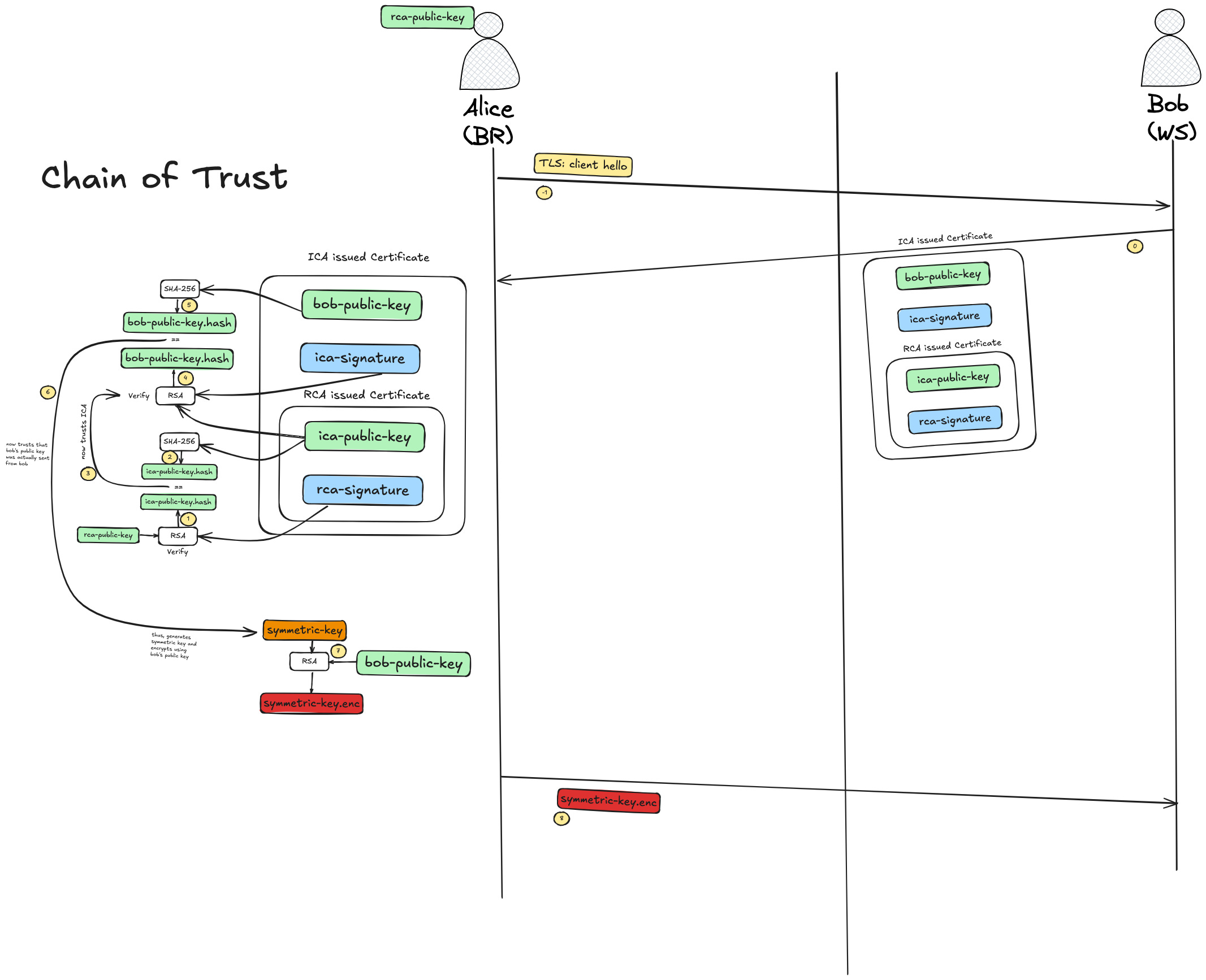
Step 1: Verify ICA
Verify(RCA.pub, ICA.signature)If valid → browser now trusts ICA
Step 2: Verify Server
Verify(ICA.pub, WS.signature)If valid → browser now trusts the web server (Bob)
7. TLS Handshake — Establishing a Secure Session
Now that trust is established, we need a shared symmetric key.
Old Approach (RSA Key Exchange)
Client generates symmetric key
Encrypts with server public key and sends to server
Server decrypts using private key
Problem
If attacker gets server private key later:
→ past sessions can be decrypted
Modern Approach: Diffie-Hellman (ECDHE)
Instead of sending the key, both sides derive it independently.
Intuition
Both sides agree on
gandpClient picks secret
aServer picks secret
b
Exchange:
Client → g^a mod p
Server → g^b mod p
Then:
Client computes: (g^b)^a mod p
Server computes: (g^a)^b mod p
Both get:
Key Insight
The shared secret is never transmitted.
Why this is powerful
Provides Forward Secrecy
Even if private key is compromised later:
→ past sessions remain secure
8. Final TLS Flow (Putting Everything Together)
Browser connects to server
Server sends certificate chain
Browser verifies:
Root → ICA
ICA → Server
Trust is established
Client & server perform ECDHE key exchange
Shared symmetric key is derived
All further communication uses symmetric encryption (AES)
9. Why This Design Works
This system combines:
Asymmetric crypto → identity & trust
Hashing → integrity
Signatures → authenticity
PKI → global trust system
Diffie-Hellman → secure key exchange
Symmetric crypto → performance
10. Final Mental Model
Think of HTTPS as:
Certificates → prove identity
Signatures → prove authenticity
PKI → establish trust
TLS handshake → agree on secret
AES → secure communication
Closing Thoughts
What looks like a simple 🔒 in our browser is actually:
a distributed trust system
built on cryptography
standardized through PKI
and optimized over decades
In this article, we built the foundation:
Asymmetric cryptography → identity and signatures
Hashing → integrity
PKI → global trust
TLS → secure communication channel
But this only solves one part of the problem.
TLS ensures we are talking securely to a server.
It does not answer who the user is or what they are allowed to do.
What Comes Next
Once a secure channel is established, modern systems need to answer two critical questions:
Who is the user? (Authentication)
What is the user allowed to do? (Authorization)
In the upcoming articles, we’ll build on this foundation and explore how real-world systems solve these problems:
JWT (JSON Web Tokens)
→ How identity is represented and verified across servicesJWKS (JSON Web Key Sets)
→ How public keys are distributed and rotated at scaleOAuth
→ How applications securely delegate accessAuthorization Models
Role-Based Access Control (RBAC)
Attribute-Based Access Control (ABAC)
Policy-Based Access Control
Real-World Systems like AWS IAM
→ How these concepts come together in production systems
The Bigger Picture
If TLS answers:
“Can we trust this server and communicate securely?”
Then the rest of the system answers:
“Can we trust this user, and what are they allowed to do?”
By the end of this series, we won’t just understand individual concepts like JWT or OAuth in isolation—we’ll understand how they fit together into a complete, real-world authentication and authorization system.